por
Tebi
/
Six hundred guests, ten staff, drinks in three minutes. Barricade ran its busiest night ever on the same setup it uses for a quiet Tuesday.
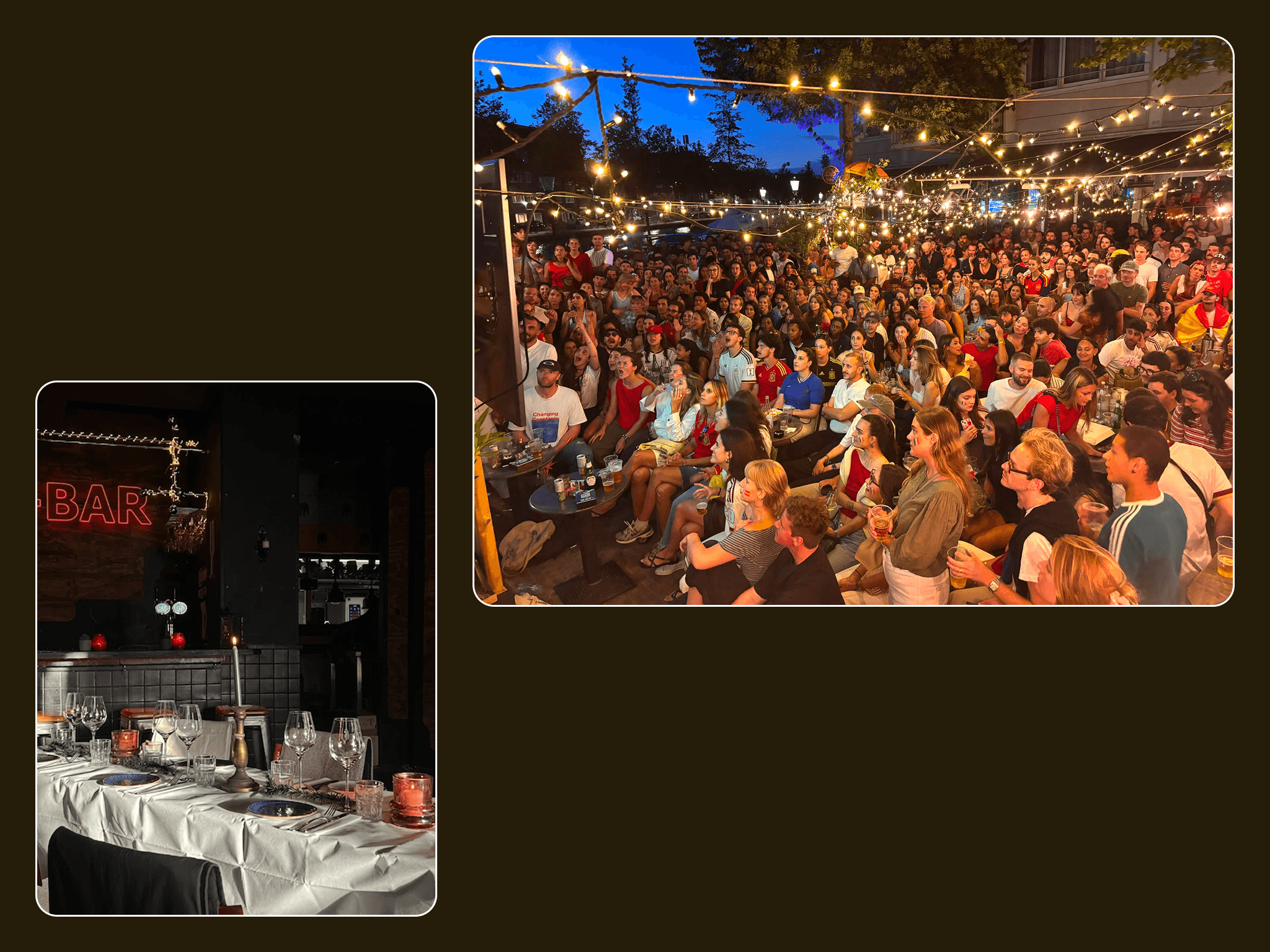
Barricade and Barrica sit a few streets apart in Amsterdam, run as a crossover between a tapas bar and aperitivo bar by owner Bart. Most weeks, the room holds anywhere from 20 guests to 160 guests. During the World Cup, they served as many as 600 a night. Here is what let it grow from a normal service night to its busiest one yet, without the service missing a step.
On a normal service night, Barricade runs anywhere from twenty guests to a hundred and sixty, with about ten people on the floor once the room fills up. On the loudest night of the World Cup, that same ten-person crew held six hundred guests. Nobody was added to the schedule, nothing was swapped out overnight. It was the same crew, working the same system, at a completely different scale.
Bart opened Barricade in October 2023, and last September he brought Barricade and Barrica together under one kitchen and one menu: quality ingredients, simple prep, wine and pata negra and manchego and anchovies he imports himself from Spain. Forty-one people work across the two venues, about twelve of them rotating between rooms depending on the night.
Bart treats moments like this as a project, not a problem.
"If we see an opportunity, we make it a project," he says. And one person of the team then gets the full responsibility and mandate. "Tebi helps us make these projects real.”
The World Cup was one of those projects.
Twenty guests, or six hundred
The World Cup turned the terrace into a neighbourhood square. Footfall swung from a hundred people on a quiet afternoon to six hundred on a night with a big match, and across the tournament the venue saw about six thousand extra visitors it wouldn't otherwise have had.
On the busiest single day, Barricade poured almost 15% of the beer the place normally sells across a whole year.
None of that showed up as a separate system bolted onto the floor for the occasion. The same reservation book, the same till, the same kitchen ticket flow that ran a normal service night for twenty guests ran the tournament's busiest night for six hundred.
On a normal night, that means a table moves from reservation to sale without a second system involved: the order fires to the kitchen or the bar, lands at the right prep station, and the guest pays however suits them. For an event, big or small, the order comes in differently. A guest orders by scanning a code, payment happens the moment the order goes in, and the ticket already knows which station it belongs to. Either way, the order ends up in the same place, and service stays just as fast.
What changed was how the room was organized, not what it ran on.
The floor moved, the system didn't
"Thanks to Tebi, we didn't have to build anything new," Bart says. "We used the exact same system we run day to day. We just pointed more people at it."
For the biggest nights, Bart split the terrace into two zones inside the same floor plan. One section kept full table service. The other became self-service, pointing guests to a small bar station so the queue never backed up into the main room.
Guests in the service zone ordered from their phones at the table with QR ordering; guests at the bar ordered at the counter. Either way, the order landed in the same kitchen and bar tickets as everything else that night.
Stock and menu changes went in days ahead of a match, and when something ran out mid-shift, the team would pull it from every menu with one tap. It disappeared everywhere at once rather than needing a runner to explain it table by table.
At the bar, tickets were still printed on paper rather than showing on a screen, each one stapled to its drink so whoever delivered it could read the table and the name at a glance. Of the three runners and four bar staff covering the busiest nights, one worked the ticket printer full time, and the team built in three twenty-minute breaks to clear any backlog before it grew.
One review from that week read: "Even with hundreds of people, we had drinks within 3 minutes.”
None of this was new to the tournament. Bart had already run the same ordering flow at a private dinner for 26 guests, where each place setting got its own code so the host could cover food and wine while guests ordered their own drinks. The tool that ran a table of two on a quiet night was the same one that ran a terrace of six hundred during a match. Nobody had to learn a second system for the busy version of the job.
What carried over
By the end of the tournament, the same crew that had run Euro 2024's best night more than doubled that night's business, without a single extra hire. July was tracking to roughly double a normal month, even with a week closed so the team could rest.
"Before Tebi, our best day earned about half of what we earned this time, with the exact same team. That was not luck. My team worked very hard and stayed focused through every match. Tebi did not slow us down. It helped that hard work turn into real results.”
– Bart, Owner, Barricade and Barrica
The tournament didn't just prove Barricade could handle more people. It proved the service didn't slow down to do it: guests were still getting their drinks in minutes with the terrace packed well past its normal capacity.
None of that came from switching tools between a quiet night and a packed one. It came from not having to. That's the part that's easy to miss from outside. A connected system isn't loud about the nights it handles well. Nobody on the floor was thinking about the software while the ticket printer ran hot or the terrace filled past capacity, because the booking, the floor, the kitchen, the bar, and the till were never separate problems to begin with. They were the same system, doing what it does on a normal night, just louder.
Barricade still runs on the same setup it used before a ball was kicked. A normal service night and the loudest one of the year, and nothing in between them had to change: not the schedule, not the system, and not how fast a drink reached the table.
"We could've never done this without Tebi," Bart says.
See what a connected system feels like in service. Talk to us.